
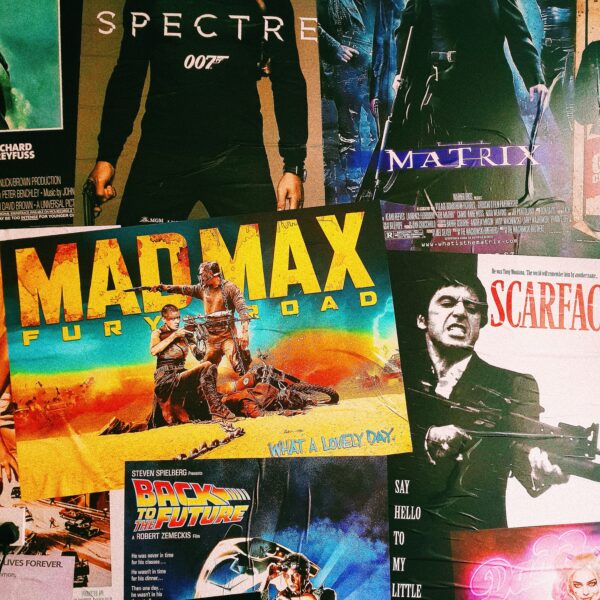
The Most Iconic Movie Posters of All Time
One of the most important elements of any film production is the design of the movie poster. The aim of a good poster is to summarise the movie graphically and give us a flavour of what to expect from the film. The most iconic film posters are extremely collectable and often fetch large sums at auction.
Framing Iconic Movie Posters
Many of us have stuck a film poster to the wall with Blue-Tack or drawing pins, but framing a poster of any value properly provides a number of great benefits: It transforms the poster into a talking point and helps to protect it from accidental and atmospheric damage. It can also give the poster a personal style that adds to its impact as a work of art. See below for a short list of some of the most iconic movie posters of all time and how they could be framed.
Pulp Fiction
Quentin Tarantino’s 1994 cult classic Pulp Fiction was and still is a truly iconic film. The artwork is punchy, bright, and instantly recognisable around the world. It of course features the actor Uma Thurman (who plays Mia Wallace) lying seductively on a bed, smoking a cigarette with a gun and pulp magazine close by. The photographer, Firoo Zahedi, constructed a seedy motel room setting inspired by the film noir pulp fiction books of the ‘50s and ‘60s. It has the retro feel of the classic pulp magazine style. Rather than referring to the film itself, the artwork expresses the film’s central themes of crime, violence, seduction, and pop-culture. We have framed several examples of this poster with a standard 20 x 30 frame profile custom sprayed to a colour matched to one in the artwork.
Parasite
Korean black comedy thriller Parasite was to 2019 what Pulp Fiction was to 1994 — an impossible to ignore, sensational of a movie. This film poster is a fantastic piece of art, and influenced a host of other designers to create inspiring commercial campaigns and fan art. The original poster was designed by film director, art director, and composer Kim Sang-Man. It depicts a ostensibly domestic scene featuring the main characters. However, coloured bars conceal their faces: black for one family, and white for another, alluding to how the families are portrayed as opposites in the film. Meanwhile, to the far left of the poster is what appears to be a body on the floor. All in all, the poster has the power to unsettle viewers as well as pique their interest.
Star Wars
Star Wars is one of the most transformative series of films ever made, and the film posters are highly sought after. Known as Style A, the poster for the original 1977 film was created by Tom Jung. It features main characters Luke Skywalker and Princess Leia against a background of spaceships and promotes the adventurous atmosphere of the film. Due to the film’s massive success and long run at cinemas across the world, several more iconic variations of the poster were created to maintain the momentum of the advertising campaign.
Scarface
Scarface, despite its original uninspiring reviews, became a global hit and is seen as a landmark movie of the ‘80s. The film poster is a simplified, black and white graphic of Al Pacino’s character, Tony Montana, holding a handgun. The title is outlined in red at the top, with credits to one side and the film blurb on the other. It’s a classic and simple image that perfectly expresses this American gangster film’s simplified moral universe of drugs, guns, power and money.
The Silence of the Lambs
The Silence of the Lambs movie poster’s central image features Jodie Foster (who plays Clarice) with a death’s-head hawk-moth covering her mouth. The insect has a skull on its back made up of the nude female form, which represents Hannibal Lecter’s obsession with women. There is another version featuring Hannibal in red tones, but Clairce’s one was most powerful. It is both visually appealing and directly links to the film. The moth is particularly important as it’s the creature that fascinates one of the film’s other serial killers, Buffalo Bill.
How we Frame Posters at Soho Frames
We have extensive experience handling and framing movie posters of all types. However, the process isn’t as simple as placing an image in a standard photo frame, and is different depending on what type of movie poster it is. These fall into one of two groups: pre ‘80s and post.
Before the 1980s, film posters were printed on old-fashioned paper stock. We call these vintage film posters. These often arrive folded and sometimes with tiny holes in the centre where the folds cross over. It is best to stabilise these types of posters before we start the actual framing. Film posters made after the ‘80s are printed onto plasticised paper stock and are usually double-sided. It’s often a good way to tell if a poster is an original cinema film poster and not a copy or reprint.
Pre-1980s posters
Pre-1980s movie posters can be preserved by being backed onto linen. This is a permanent process that softens and flattens folds (but doesn’t completely make them disappear). It stabilises the paper and makes it robust enough to either store or frame. Backing posters onto Japanese Rice Paper offers similar advantages with the added bonus of being removable if necessary. Both of these processes are carried out by highly-trained experts or conservators. We work with several professional paper conservators who can carry out this process. Please contact us to find out more.
Post 1980s posters
Linen-backing involves soaking the film poster in a mixture of water and adhesive and slowly drying it over a few weeks. This process does not work on the plasticised paper used to manufacture post 1980s film poster. However, there are several other ways to stabilise these types of film poster. They can be drymounted, although this should not be done on anything valuable and / or irreplaceable. Drymounting is often used by film production companies, SFX specialists, etc, who would like a record of the films they have contributed work to for their office. Valuable posters are often best hinged into window mounts with reversible Japanese archival tape. If they are creased or wrinkled, sometimes seen when improperly framed, then this type of damage can usually be addressed by backing onto Japanese Rice Paper. Once backed, they can be framed in a variety of mounting styles.
How To Minimise Wrinkling in Post 1980s Film Posters.
The best way is to ensure there is an air-gap between the glass and the poster. This is because moisture inside the air inside the frame can cause damage like buckling and warping when the poster is in contact with the glass. One method is to use a spacer, which is a strip of either acid-free paper-wrapped wood or acrylic that separates the poster and the glass. A spacer can be as unobtrusive as 1.5mm. A spacer is usually used when the desired framing style is straight-to-edge. An alternative is to window mount the poster.
As mentioned earlier, film posters that are easily replaceable or not extremely valuable can be dry-mounted onto a standard foam or Kappa board, a process that is permanent and relatively inexpensive. That said, drymounted posters can sometimes be removed from these types of backing, but it is a difficult and expensive process and is always carried out by a conservator. Clients are reminded that drymounting is always done at the owner’s risk as the poster goes through a set of rollers and although uncommon mishaps can occur like bubbles or wrinkles. We only guarantee a perfect result if we print the poster ourselves. This is a standard industry-wide caveat.
In Summary.
We have framed thousands of film posters over the years, both vintage and modern, using all the processes outlined above. Don’t hesitate to get in touch with us if you’ve got a special movie poster you’d love to have framed for your own home or office environment. And always remember, our advice is free.
How to personalise your frame
Many of our clients tell us they have spent a lot of time looking for a picture frame for their artwork, but then realise that they need something very bespoke and customised to display it. They want something totally individual that suits their taste, the art itself, while also complimenting their home décor. And that’s…
Read More