Mounting & Framing Style FAQs
MOUNTBOARD TYPES
Q. What framing style is best?
A. Whatever framing style is used to frame a particular artwork depends both on the type of artwork to be framed as well as the personal preference of the client. However, a good picture workshop will be happy to go through all the options with you and advise what is best.
Q. What sort of mountboards does SohoFrames offer?
A. We offer three types of mountboard. Conservation board, Archival board and Museum board.
Q. How many different types of mountboards are there?
A. There are three main types. Conservation board, Archival board, and Museum board.
Q. What colours is museum board available in?
A. The range of available colours of Museum board is limited to soft white, cream, ivory, but also black.
Q. What is Conservation board?
A. These boards are usually 1.4mm thick, are acid-neutral and so will not damage any artwork by leaving those brown wood stains often seen on artworks framed with poor quality mountboards. This board is usually a composite made with a white core and then a face paper, which can be in a wide range of different shades and colours, including gold, silver and some linens.
Q. How does Conservation board differ from Archival board?
A. Archival boards are solid core and acid-free. There is also a greater choice in terms of board thickness, which varies between 1.5mm and 2.2mm, depending on type. This extra thickness gives a very nice wide bevel that really sets off an artwork of whatever type. We highly recommended this board because of its quality. The colours of this board are more limited ranging from soft whites through to creams and then ivory, which is a soft yellow colour.
Q. How is Museum board different from Conservation and Archival mountboards?
A. Unlike other mountboards, Museum board is made from cotton instead wood fibres. This gives the board a beautiful almost velvety texture and is of the very highest quality. It is available in two sizes, 4-ply, and 8-ply, which is around 1.5mm for the thin board and 3.2mm for the thicker board.
Q. Apart from its quality does Museum board have any other advantages?
A. It does. At 1524mm x 2400mm this board offers the largest sheet size of all the mountboards on offer, making it ideal for float mounting large artworks.
WINDOW MOUNTING
Q. What are the advantages of the window mount style?
A. A window mount works at both a technical and at an artistic level. Artistically it serves as an intermediary device that smooths the transition between an artwork and the edge of the picture frame. At a technical level it created an air gap between the artwork and the glazing.
Q. I would like wider mount margins than shown in the visuals. Is this possible?
A. Of course. We make all mounts to exact specifications.
Q. Does colour make a huge difference?
A. It does! It’s often difficult to say why one certain colour or shade works with an artwork and another doesn’t. Choosing the right colour is a question of experience and trial and error.
Q. What if none of the standard shades and colours of mountboards work with my artwork?
A. We can custom spray mountboards to exact specifications.
Q. Can I order a window mount just by itself?
A. Of course. We can usually make single or even multiple window mounts of the same of different sizes while-u-wait. The maximum outside board size for this while-u-wait service is approx. 800mm x 1100mm. It can be up to 1200mm x 900mm for some classes of mountboards. “While-u-wait” does depend on stock and how busy we are and can take anything from a few minutes up to an hour.
Q. What is the most popular margin width for a window mount?
A. The width of the margins is ideally decided by the visual effect of the entire piece. It should look balanced. Too small a margin can make a work look pinched. Too large and it can look lost. It does depend on the type of artwork too. Some small artworks look fabulous in the very large window mounts while others can appear lost. Through trial and error and the framer’s / artist’s / client’s opinion the right size margins can be determined.
Q. When would the width of the mount margins not be ideal in terms of achieving a balanced look?
A. When two of the elements have a fixed size. For example, when an artwork or print must be fitted into a ready-made picture frame that is larger than the artwork or print in question. A window mount is used to fill the excess space. Depending on the sizes of the two fixed elements the resulting mount margins may be quite different. It’s a compromise.
Q. Do the width of the mount margins really matter?
A. When the chosen colour is correct and the widths of the margins are proportioned correctly, the window mount gives the picture frame a beautifully balanced look.
Q. What can be done to fix this?
A. We can often make small adjustments to make the fit more pleasing, for example, by bringing the mount into a photograph a little on one of the dimensions if the composition of the image allows it. This compromise is often needed when attempting to fit the A-sizes together. Example: An A4 print does not fit nicely into an A3 ready-made frame, which would be the next standard size up. If this was done, the margins on the long side of the window mount would be approx. 61mm and approx. 43mm each side on the short side.
Q. I would like a window mount made with a super deep bevel, perhaps 10mm. Is this possible?
A. Yes, it is. At SohoFrames we have two CNC mount cutting machines that can make window mounts with super accurate cleanly cut bevel edges. The machines are so accurate that we can stack two or more boards together to give the look of a single seamless very deep bevel cut.
Q. What does double mount mean?
A. A double mount is when two window mounts are used. There is usually a margin between each. It is often done for two main reasons. The first is when a slim margin of colour around the artwork would accentuate it. The outer mount would then be white or cream, for example. The second reason is to increase the 3D effect that a window mount creates thereby channelling the focus onto the artwork in two stages. This is often used with smaller artworks. It allows for a larger frame to be used without the artwork becoming lost in it.
Q. I want to order a window mount for you. How do I measure correctly so it fits?
A. Measure the glass size of the frame the mount is supposed to fit into in millimetres. It is a good idea to begin the measurement 100mm from the start of the measuring tape, using “10cm or 100mm” as the beginning. This ensures an accurate outside measurement. Remember to reduce the result by 100mm! Then measure the artwork. If the aperture of the mount is “fit to image”, then measure the artwork and then reduce this measurement by 2-3mm for both the vertical and horizontal size. Or, simply bring everything in to us and we will measure and cut the window mount for you.
FLOATED ARTWORKS
Q. What is a flat float?
A. The flat float is a mounting style where the artwork lays flat onto the backing mountboard. It won’t be stuck flat, just gently attached at various points to give it a natural look. This gives the illusion that it is “floating” on the mountboard. It is often only hinged at the top only, but this does depend on the size of the artwork. This process won’t flatten a rippled or warped artwork.
Q. My artwork is rippled and needs flattening. Will a flat float fix this?
A. There are several things we can do to rectify artwork issues like this. Whichever method is chosen depends on the artwork, the severity of the wrapping, buckling, creasing, as well as the budget. Resolving some issues can be costly and necessitates the services of a qualified paper or art conservator if further damage is to be avoided.
Q. What is the difference between a flat float and a shadow float?
A. A shadow float is where the artwork has the appearance of hovering above the backing mountboard.
Q. When my artwork was removed from the packing tube I noticed it was dented. What caused this?
A. The most common form of damaged are “roll dents,” and / or “impact dents” (where the artwork bumps against the unprotected caps). These often need a conservator to remedy properly.
Q. Why would a shadow float be chosen over a flat float?
A. Both floating methods show the edges of an artwork. Shadow floating is a method often used on works of art that have ragged edges. Lifting the artwork a few millimetres away from the backing mountboard creates a pleasing 3D shadow effect around it.
Q. The artwork isn’t dented, but it is rippled. What can be done to flatten it?
A. Many ripples in the paper can often be adequately flattened with gravity. Yes, it’s true! The planet can do a lot of this work by simply resting the artwork on an archival board. After a few days under gravity many artworks relax and flatten out by themselves. Sandwiching between two boards can often speed or help this process due to the extra pressure. Care must be taken not to crease the artwork when placing the second board on top. A conservator can also humidify certain artworks to relax more stubborn creases and ripples.
Q. What framing or mounting style is best for translucent artworks?
A. Window mounting works well with translucent artworks as any tape used to secure the artwork in place cannot be seen.
Q. How best to address the ripples on a previously rolled and now rippled painting on canvas?
A. Rippled canvases are often hung under weight to achieve the same effect. Other methods like backing onto rice-paper, drymounting or heat presses are also employed too. Our advice is to speak to us first before attempting any DIY remedies. Or contact us with some information and photos and we can advise you of the best steps to take.
Q. How is this “hovering” look achieved?
A. The artwork is first mounted onto a support plinth, typically 5mm foamboard, the board cut smaller than the artwork so that it is hidden behind it.
Q. Can an artwork be framed without the use of tape?
A. Yes, we often float artworks where “minimal intervention” is required onto mountboard, holding the artwork in place with acid-free acrylic corners. The acrylic corners can be hidden by placing a window mount on top, something we call a presentation mount. This method means that the artwork will look exactly the same if it is ever removed from the frame as when it went in.
Q. Can any artwork be shadow floated?
A. Shadow floating is a technique or mounting style that does not work well with translucent artworks. This is because the tape used to secure the artwork in place often shows through.
MOUNT MARGIN SIZING
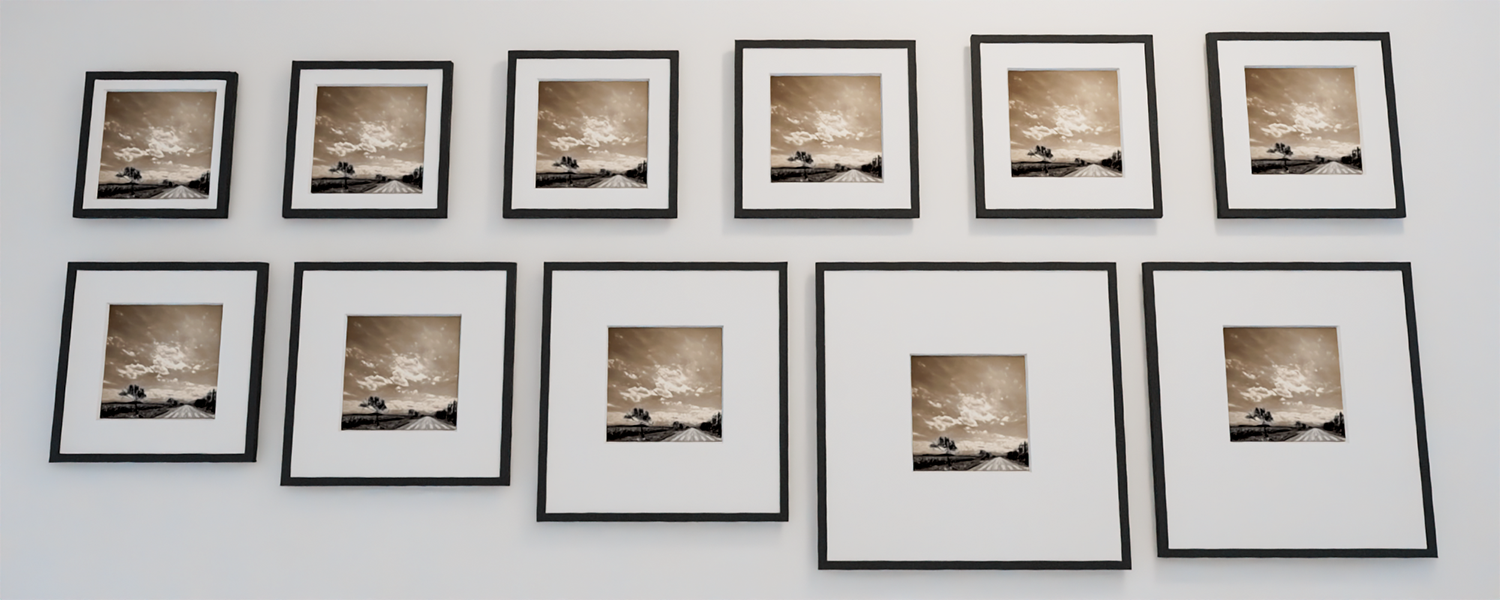
How to choose the correct size of mount margin for a given artwork is a bit of an art. it is usually a question of seeing what looks best by placing mount and frame samples around the artwork in our workshop. That along with our advice and experience ensures a successful framing result. The only caveat is if the frame size is fixed for some reason. This could be because of the wall space the frame must fit into or if you require us to fit the artwork into an existing frame.
The photograph above shows a series of eleven renders (the image shows a real scene taken in Sanpetru in Transylvania © SohoFrames). Each render features an image size of 200mm x 200mm. We picked a square image because mounting square artworks is often tricky to make them look right.
Refining Mount Margin Size
When going through a framing consultation with us and a window mount or float is requested but the client is unsure of the size we always start with a measurement we know works for almost any image. This is 50mm all round overall, which is approximately 44mm all round visual due to the frame lip (rebat). We can then make any adjustments as needed and supply renders to confirm.
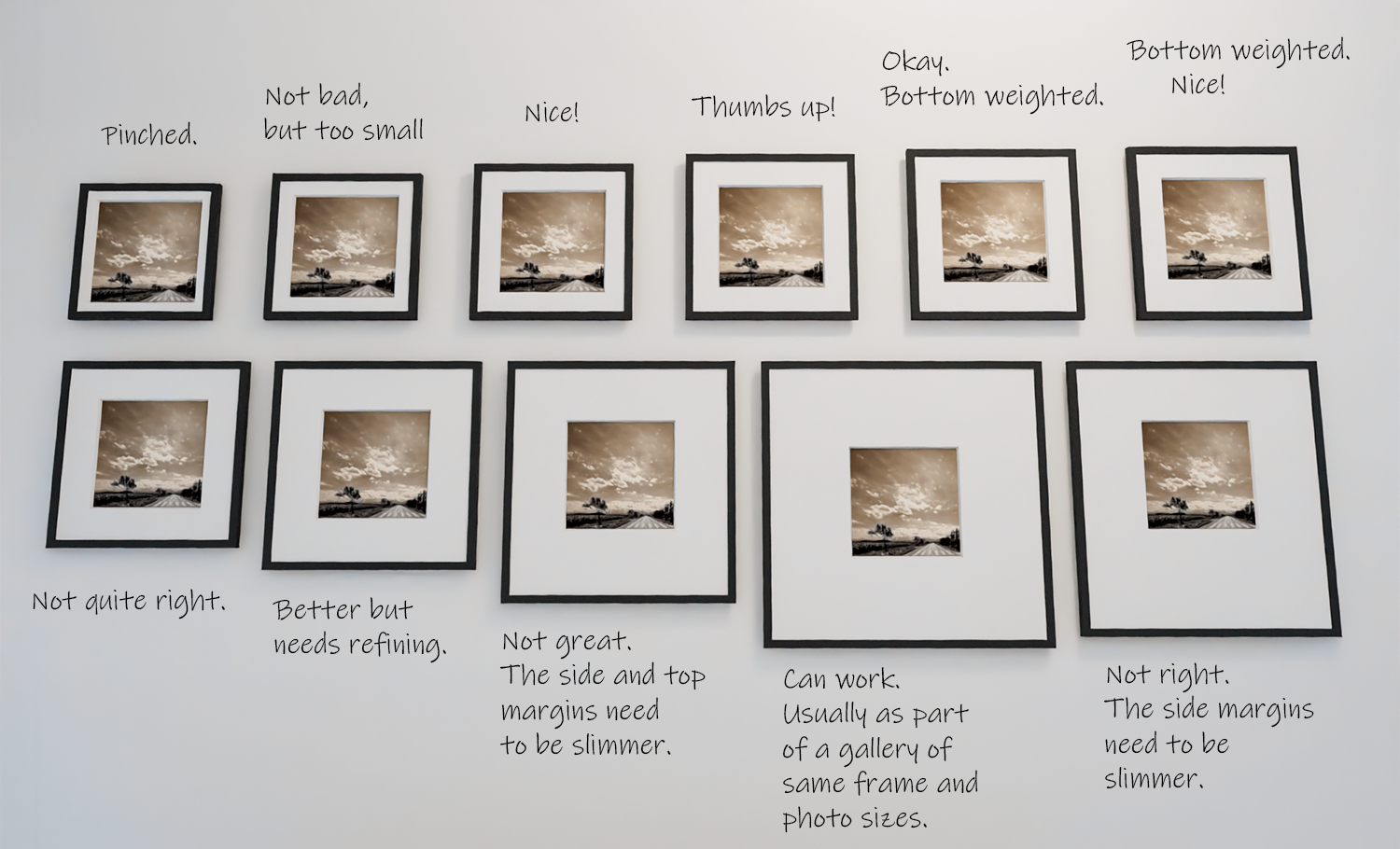
A small mount margin often makes the overall frame look a bit pinched. An artwork must be able to breathe within the frame. Too large a mount margin can make an image appear lost within the frame. The secret is balance. a 40mm-50mm overall mount margin often looks just right. Bottom weighting also works very well. The usual method is to keep the top and side margins the same width but extend the bottom margin by 50%. Have a look and let us know what you think. Then look at the annotated render below to see our own comments. (image 4 has borders of 50mm all round by the way).
Of course, it is possible to place relatively tiny images into very large frames. The margins can therefore be very large but the ratio of the top and the sides to the bottom margin still follow the same principle. It is also possible to refine this type of very unequal mounting by “slimming the frame” using side margins that differ from the top and the bottom.
Have a look at the various images and write down which one or ones you think look balanced and aesthetically correct.
The eleven mount margin sizes of each image are as follows. Starting at the top row from left to right, then bottom row left to right.
STRAIGHT TO EDGE
Q. What is the straight to edge or full bleed style best for?
A. Again, it does come down to personal preference, but this is a popular framing style for certain types of photography, particularly large photography, as well as film and art posters. Spacers and a same-size float may also be required with this style.
Q. What is a spacer?
A. A spacer is a narrow piece of acid-free paper-wrapped wood or acrylic used to push an artwork towards the back of the picture frame. Spacers are often made from mountboard too. Spacers are always recommended with floated works but are also used in conjunction with the straight to edge style. Furthermore, they can also be used with window mounted artworks. It’s just a question of style and personal preference.
FLOATER FRAMES
Q. What is a floater frame?
A. A floater frame, also called a canvas floater frame or a tray frame, is a picture frame with a particular profile shape. It looks like an L or a standard picture frame profile turned on its side.
Q. What sort of framing is a floater frame used for?
A. It is used to predominantly frame paintings or prints on canvas or linen that is first stretched onto a support frame.
Q. Can a photograph be framed like a canvas in a tray or canvas floater frame?
A. It can, though it would first need to be dry mounted onto Dibond, aluminium or (occasionally) Kapa.
Q. What is the major difference between a floater frame and a standard picture frame?
A. A standard floater frame cannot have glass.
Q. Are there any floater frame variations?
A. Yes. There are double floater frames, and combination floater frames.
Q. Is a floater frame always necessary?
A. No. A work on canvas stretched onto a wooden or wood-aluminium composite rim can be displayed on a wall as it is. Deciding to then frame the stretched piece, which could be in either in a floater frame or a conventional rebated frame, can give the work a more finished look. However, it is just a question of individual choice.
Q. What is a double floater frame?
A. A double floater Frame has two “walls” which are separated by a moat. The walls can be different heights and thicknesses and just like the gap between the artwork and the inner wall, the width of the moat can also be customised.
Q. What is the second type of combination frame?
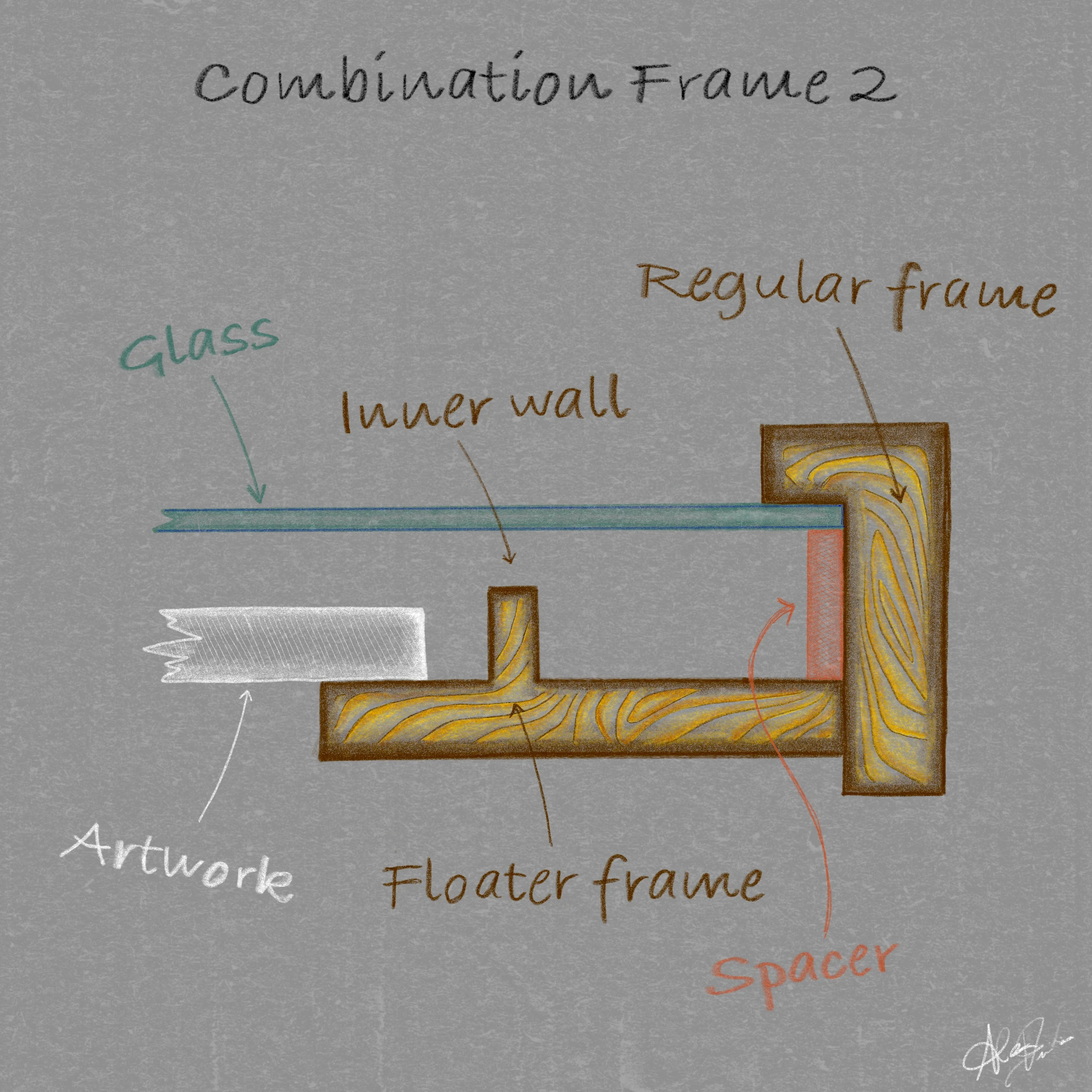
A. This is another two-wall floater frame, but one where the inner wall has a regular floater frame profile. This part of a frame is then secured into a regular picture frame profile. With this style the entire face of the frame is protected by glass.
Q. What is a combination frame?
A. There are two types. The first is a two-wall floater frame where the inner wall has a regular picture frame profile shape. It means that the centre part of the frame can have glazing to protect the artwork.
Q. Do you make all these types of picture frame?
A. We do, and everything can be customised to your exact specifications.
Q. Are the frames shown in your visuals real frames?
A. Yes, they are real and they are all displayed on the wall in our Soho workshop.
Q. Who owns the copyright to the image featured in your example frames?
A. The photograph of the London South Bank is used by kind permission of the
photographer, Alex Vintilescu. The four frame sketches on this page were also by Alex.
VISUALS
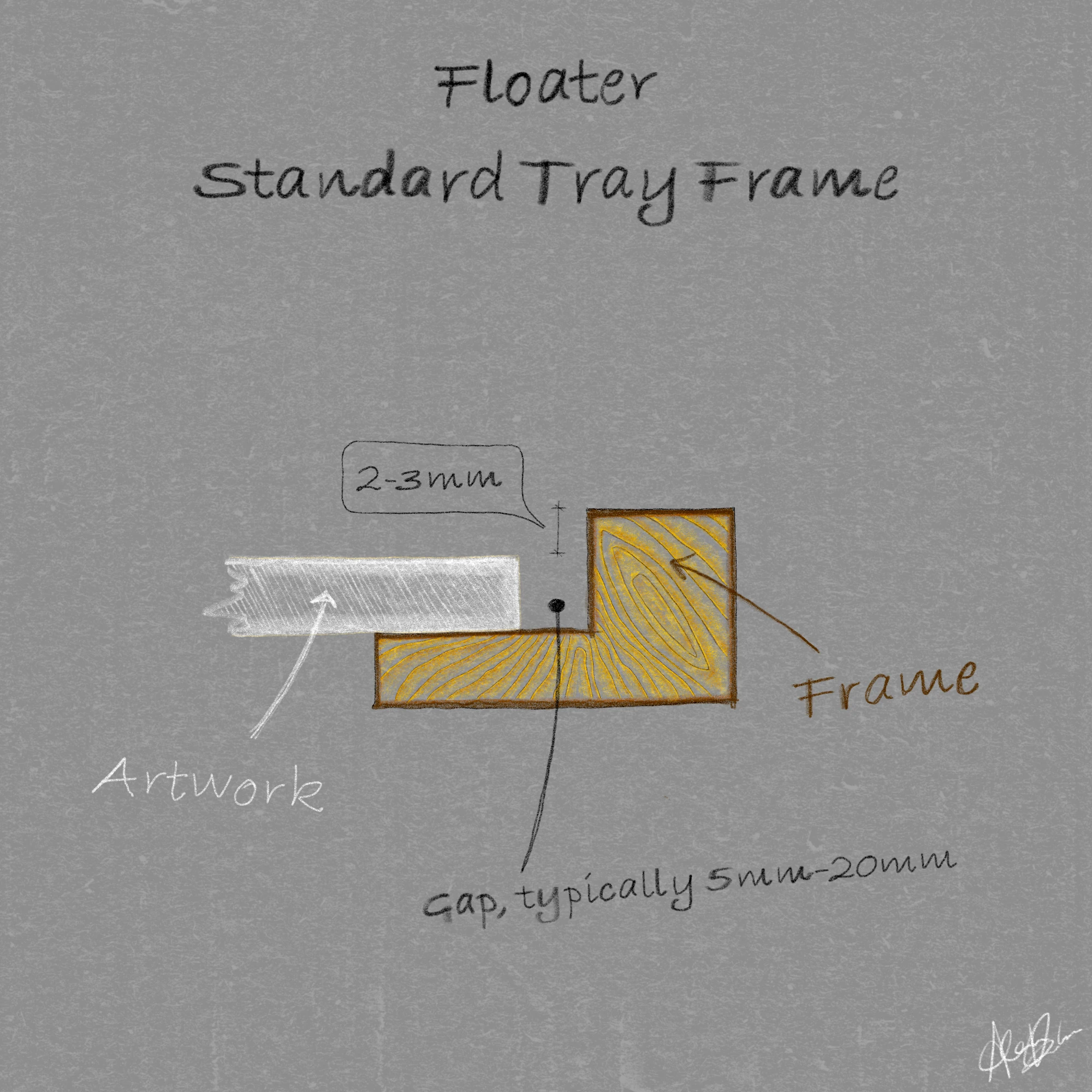
Floater Standard Tray Frame
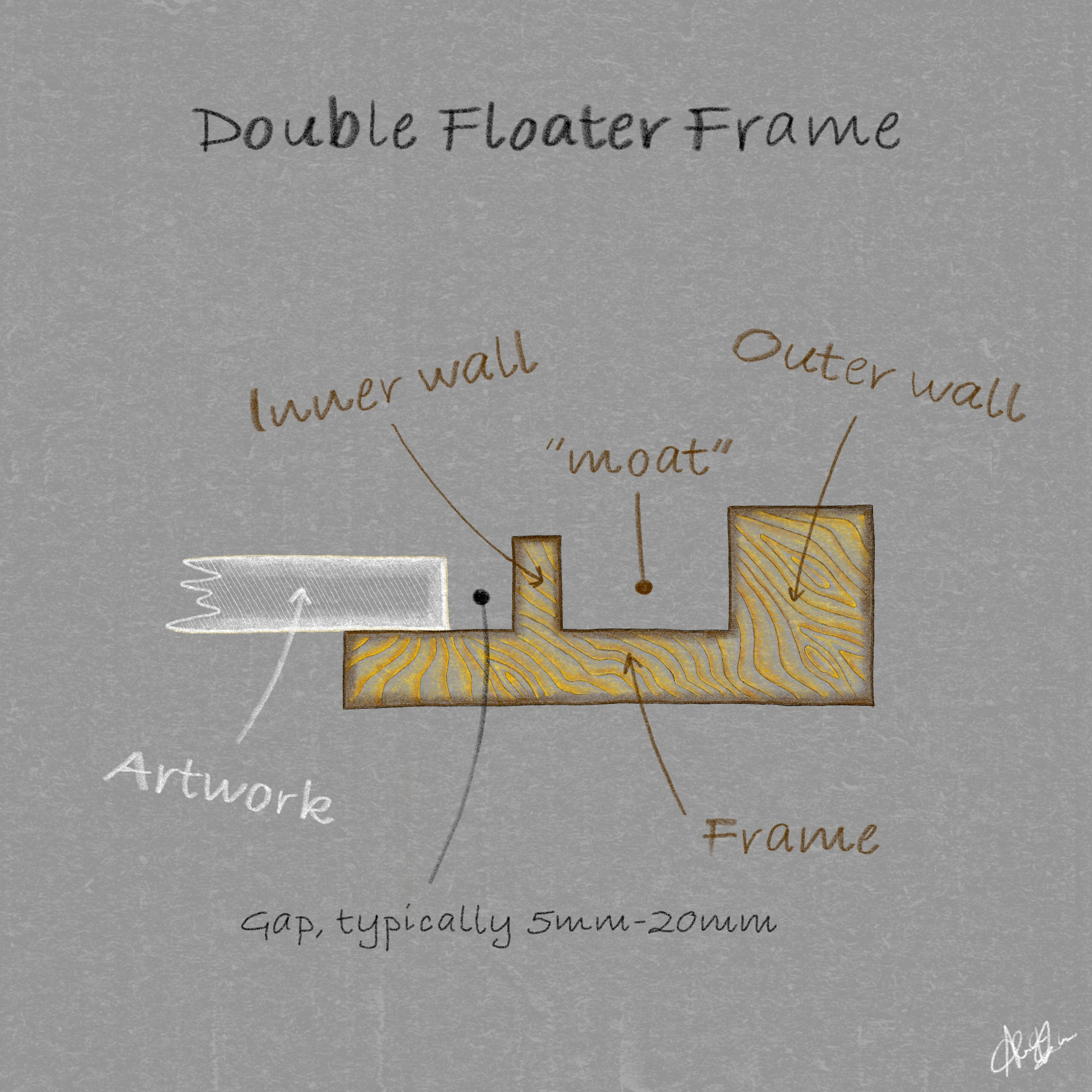
Double Floater Frame
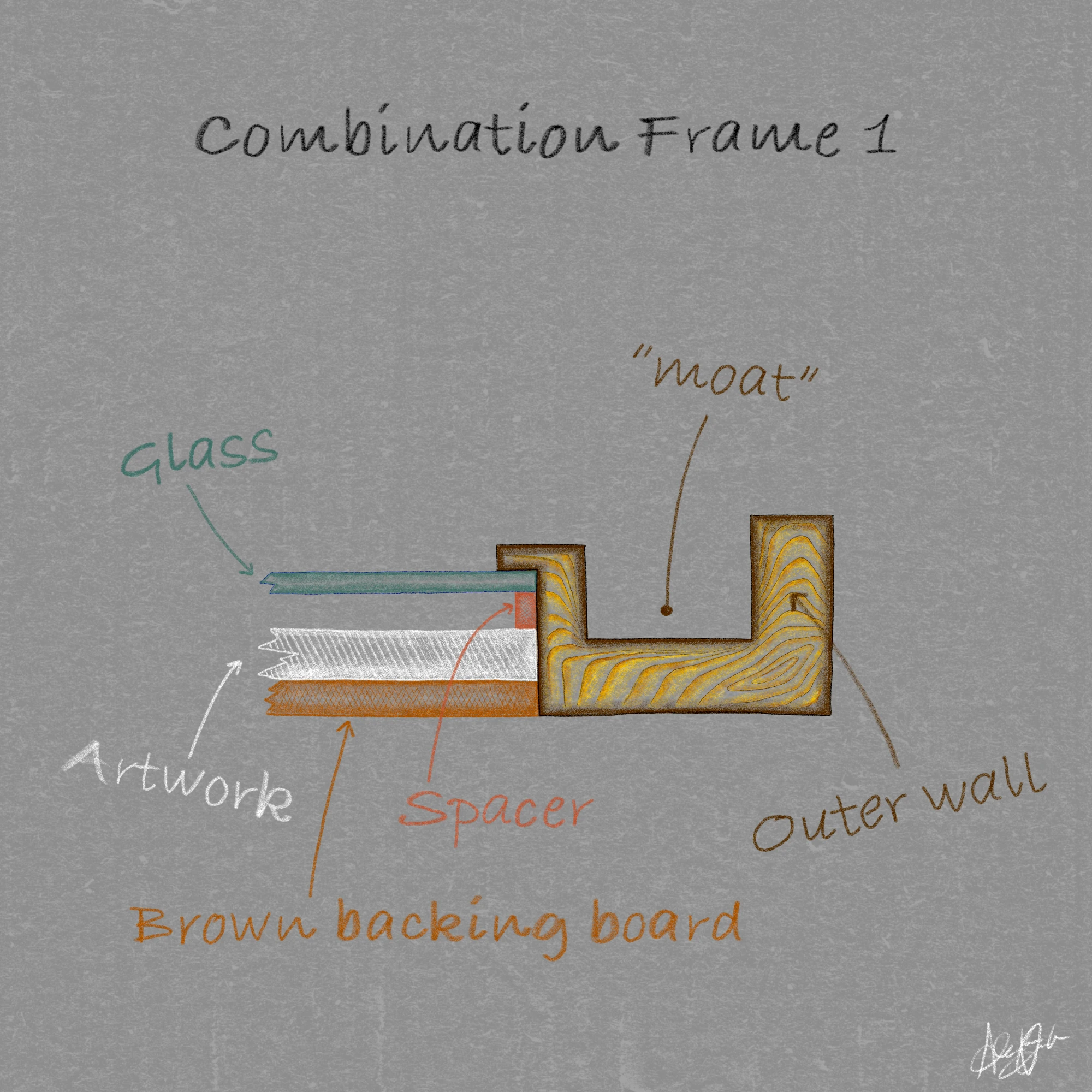
Combination Frame 1