What are the different types of glass used in picture framing?
This is an often asked question. There are many types of glazing options. Some of these are glass and some other are acrylic. The two products are often interchangeable, but there are differences.
For practically all “standard” picture framing needs you can split these many options into two simple categories. Standard float glass and anti-reflective glass.
STANDARD FLOAT GLASS
Standard float is “normal” glass. Most picture framers will order in a quantity of “half sheet” glass, which are approx. 910mm x 1200mm, a full sheet being approx. 2400mm x 1200mm. This glass is usually 2mm thick but is also available in 3mm. The thicker glass is often used for picture frames that are over the half-sheet size due to its increased rigidity and strength.
CLARITY
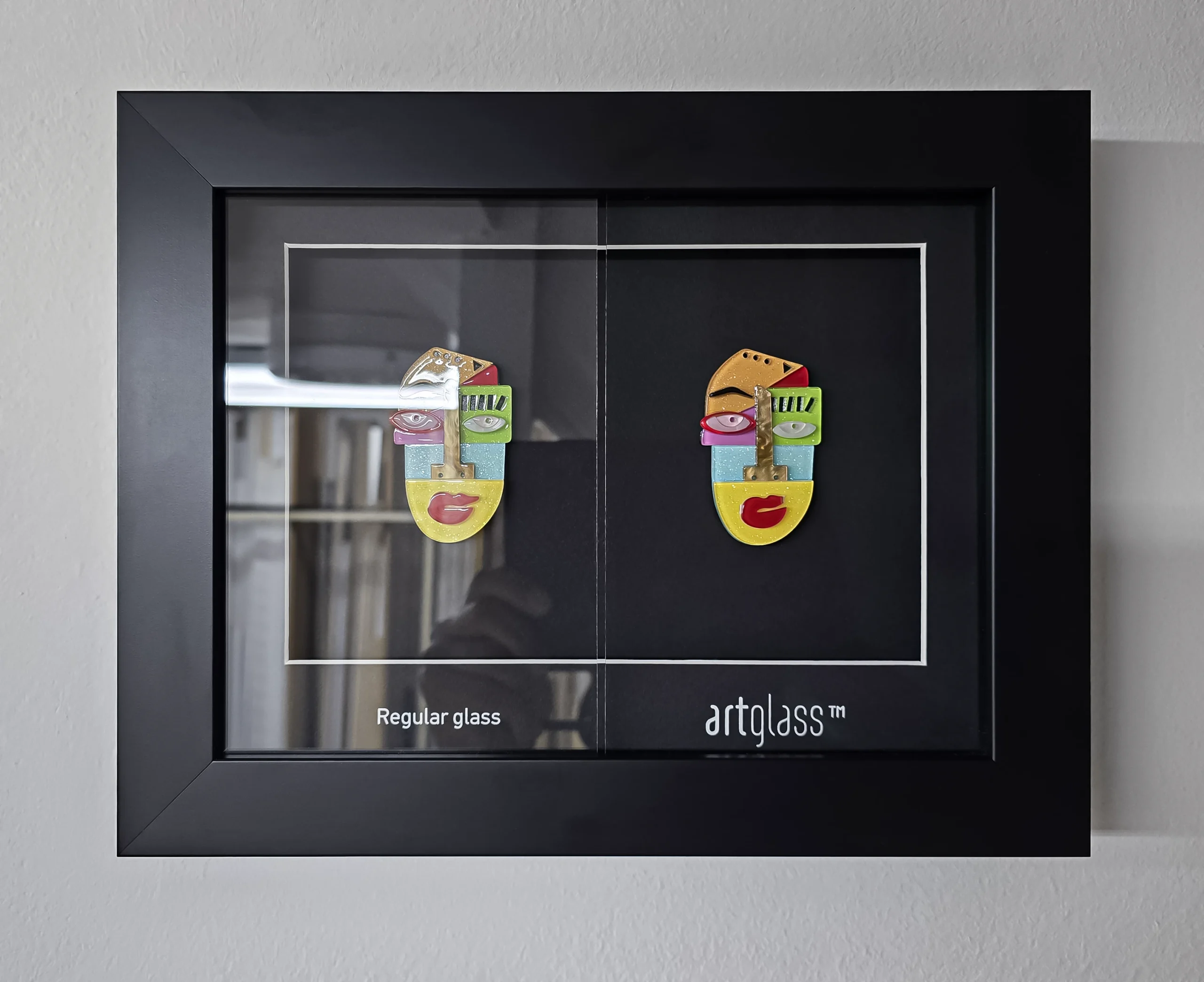
A drawback of standard glass is that it reflects enough light to often spoil full enjoyment of an artwork. 2mm float reflects approx. 9% of light and 3mm perhaps as much as 12%. And the darker the artwork, the more this reflective effect is noticed. A photograph, for example, with a lot of black tones in it, perhaps also coupled with a black window mount, can turn the entire piece into a kind of mirror. The impurities in standard glass also change the colour of the artwork. That said, standard picture framing glass is popular, cost effective, and works extremely well in many situations.
STANDARD GLASS UV PROTECTION
Standard picture framing float glass offers very little in the way of UV protection and so it is unadvisable to use this product on artworks sensitive to light.
ARTGLASS
This is the question “what are the different types of glass used in picture framing?” broadens out into a range of several different products. We call this range artglass. It is an all-encompassing term to describe higher grades of picture framing glass. This type of technical glass is anti-reflective and what little light is reflected, typically less than 1%, is as optically pure as can get for picture framing purposes. It allows the colours and texture of an artwork to be fully appreciated.
Artglass differs in two ways from standard float glass. The first is that it has a special chemical coating applied to it that makes it almost invisible in ideal viewing conditions. It is also available with various levels of UV protection, ranging from 50% all the way up to 99%, which is considered museum grade. Okay, before we move on let’s clarify. When we talk about artglass with 99% UV protection the product is described as Water White. This glass is, like the others, anti-reflective, blocks 99% of UV light but also has the highest light transmission rating, rendering it the clearest glass available.
Back to “standard” anti-reflective artglass, which is a superb product, the 70% UV version is the most popular. It is reasonably affordable and has a light transmission rating of around 99%. The next highest grade of artglass offers 92% UV protection.
Although the clarity of artglass is extremely high, its super low reflective properties can still make it look overly reflective in certain conditions and viewing angles. The best way to appreciate anti-reflective glass is to have your eyes level with the framed artwork and without direct light falling on to it.
We once still had some reflection issues when we framed (to the client’s specifications) some very large artworks for their office boardroom. However, the framed artworks were hung on the curving boardroom wall opposite an almost unbroken wall of huge sunlit panoramic windows. The unrestricted view was fabulous, but despite equally fabulous glass, due to the angle that the light struck the artglass, there were a lot of reflections.
To mitigate this, we had to use a different type of glazing.
DIFFUSED GLASS
This is standard glass but one side of it is etched, the other polished. The etched side faces out, and this face softens and diffuses the light that strikes it, so minimising any glare. Unkind people call it bathroom glass, but it is very effective in certain conditions and does not carry a premium price tag like the higher UV options of anti-reflective glass.
LAMINATED GLASS
Sometimes called toughened. Picture framers call it Artglass 99 Protect. It is essentially two pieces of 2mm anti-reflective artglass glass bonded together. Sandwiched between the two sheets is an optically clear plastic membrane. It is this membrane that gives the glass its anti-shatter properties. If the glass is struck hard enough it will craze a bit like a car windshield, but it won’t shatter. It protects the artwork from damage. It is heavy, typically being 4.4mm thick plus, and does require a different cutting technique. Laminated glass must be scored on both sides. The score line is then heated with a hairdryer or other heat source and when warm, the glass can be cracked and the membrane inside cut with a craft or Stanley knife, which allows the two pieces to separate.
We have only used this type of glass once in 15 years when framing a very large artwork for an auction house. This laminated glass has an effective UV light blocking rating of 100%. These laminated panels are ideal for very large artworks where the best protection, both against light and possible damage is required. They are available in very large sheet sizes due to their strength.
CONCLUSION
We hope this article sheds a little (anti-reflective?) light on the question of what are the different types of glass used in picture framing?! For all advice, about glazing options suitable for artwork please just contact us.
And please note, a UV protection value for a particular glass does not guarantee inks and pigments will not fade, only that it minimises the chance. Some inks, like those is certain pens and felt tips often used on autographed items will fade in time even when framed with high UV blocking glass protecting them. It’s always going to be a compromise between enjoying something, let’s call it life, and preserving something “forever.”
If you have any questions or would like to know more about glass frames, please contact us.